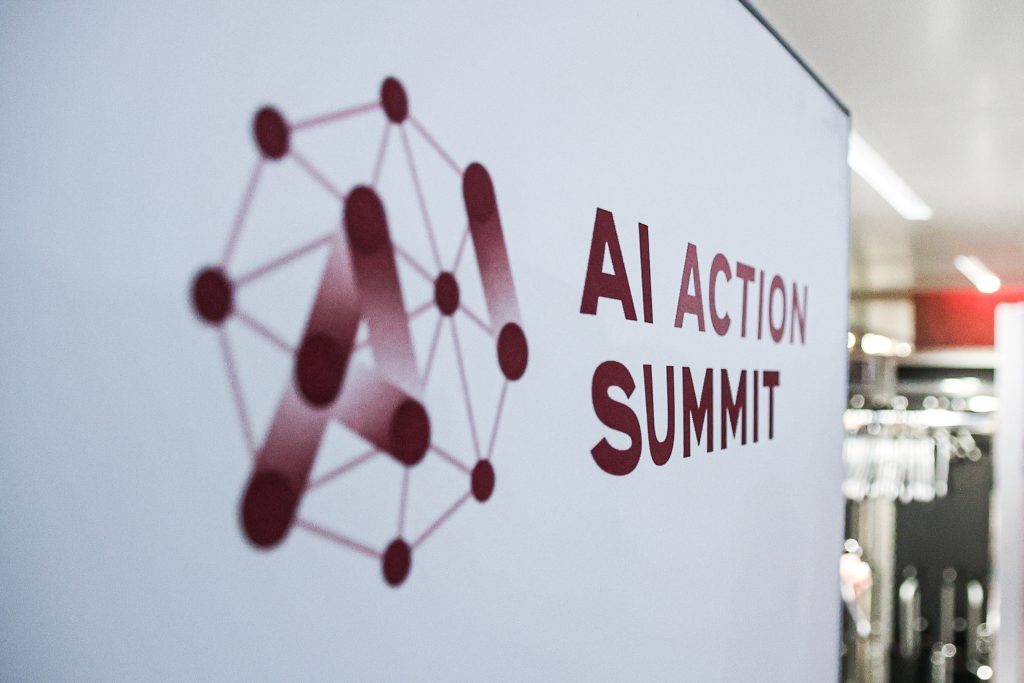
The Artificial Intelligence Action Summit, which brought together global leaders and tech executives in Paris in February, may end up being remembered mainly for the refusal of the US to sign the final communique due to Washington’s concerns that the sector risked being over-regulated.
But the event still provided a showcase for the way in which massive investment is driving advances in AI technology, as well as solving some of the problems it is throwing up.
French President Emmanuel Macron, whose government hosted the event, was keen to highlight a raft of new or recently announced AI-related investments aimed at boosting use of the technology in France and the rest of Europe.
Among these, AI cloud platform Fluidstack has agreed to build one of the world’s biggest AI supercomputers, with a multi-billion-euro investment, while Equinix has said it plans to invest €630m in a project to build 11 data centres, all but one around Paris. Mistral AI, developer of the Le Chat potential rival to ChatGPT, plans to launch Europe’s largest supercomputer. Amazon has said it will spend €6bn on developing cloud infrastructure in France by 2021.
The intention of Europe’s leaders to compete aggressively with the US, China and other major players in the race to develop AI was underscored by the launch at the event of the EU’s InvestAI initiative. Ursula von der Leyen, President of the European Commission told the meeting that the initiative would mobilise €200bn for investment in AI in the EU, including a new European fund of €20bn to finance a number of AI gigafactories.
The failure of the US, along with the UK, to sign a declaration intended to help unite the world on a path to safely and securely develop “inclusive and sustainable” artificial intelligence soured the mood in Paris. US Vice President JD Vance said regulatory measures outlined in the declaration risked strangling AI technology rather than fostering it. However, the agreement still attracted 60 signatories, including China, India, Japan, Australia, Canada and France.
Whichever side of the fence governments stand with regard to sector regulation, the evolution of AI shows no sign of slowing down.
Inevitably, that rapid pace of development raised questions in Paris over how quickly the infrastructure needed to power all the energy-hungry data centres to process information for these projects could be built.
France is unusual in that it can count on nuclear power for almost two thirds of its electricity supply. That means ramping up supply of intermittent renewable energy is not such a stretch as it is for other countries, which may need to keep fossil fuels in the energy mix for longer than they had envisaged to meet the power requirements of data centres.
But most countries, including France, face the problems of connecting up all this new power infrastructure. Fatih Birol, executive director of the International Energy Agency, told delegates that countries that have sustainable and affordable electricity supply would be “one step ahead of the others”, but getting that power to the right place was another matter.
“A data centre you build in less than one year, but the transmission lines for electricity you need about five years to build.” he said.
The huge energy requirements of the new power-hungry data centres needed to drive the AI revolution has led to much talk of an extension of the hydrocarbons age to cover any shortfalls in electricity generation. Until now, efforts to make the AI sector more efficient and cut the amount of power it requires have received less attention, but that is changing.
Perhaps the most high-profile indicator that more efficient use of power is pivotal to the sector’s future was the recent market turmoil created by the revelation that Chinese start-up DeepSeek had developed a new AI model, which it said was less power hungry – as well as potentially cheaper and faster to build – than existing comparable technology developed in western countries.
But there are also less eye-catching developments dealing with the nitty-gritty of electricity generation and distribution that could be equally influential for the future of AI development.
One example is contained in a new study from researchers at Duke University in North Carolina.
They report that, if heavy power users such as data centres can occasionally cut their power use when the electricity grid is most stressed, the current US power system could cater to demand from new sources more quickly without extensive and costly system upgrades. This offers a short-term alternative to more expensive, less climate-friendly measures to boost energy production, in a country where peak power load could grow by 20% over the next decade.
Lead author Tyler Norris, of Duke University’s Nicholas School of the Environment, said the existing US power system capacity is intentionally designed to handle extreme peak demand swings, and so could accommodate significant load additions “with modest flexibility measures”.
“Overall, the findings suggest that load flexibility offers a promising near-term strategy for regulators and market participants to more quickly integrate new loads, reduce the cost of capacity expansion and enable greater focus on the highest-value investments in the electric power system,” he said.
Part of the solution
However, there is no shortage of efforts being made to speed up infrastructure upgrades, especially by seeking to overcome the problems of assimilating intermittent solar and wind energy into electricity grids originally designed for more reliable flows of gas or coal-fired power.
As Patrick Pouyanné, CEO of TotalEnergies, told a session at the event, AI may create huge energy demand, but it is also part of the solution to that problem too.
“When you produce electricity with renewables, it’s intermittent. Today, we are developing modelling. thanks to AI, in order to optimise the way we will produce renewables, combining well with batteries… and grids.” he said.
TotalEnergies was working with tens of start-ups in an incubator on how to use AI to optimize electricity value chains between renewables, batteries, grids and trading, according to Pouyanné. “AI, in fact, is really also bringing solutions in the energy field,” he said.
Efforts at TotalEnergies reflects those around the world to find innovative solutions to meeting the power needs of data centres. Several facilities being built by global tech firms are being equipped with their own renewable power generation projects to ease the strain on the local grid. As we recently reported, new ways are also being identified to get more out of existing grid power, for example, by temporarily reducing the amount of power taken by data centres at times of peak grid demand.
(Photo: Shutterstock)