As artificial intelligence (AI) becomes embedded across operations in the oil and gas industry, more energy firms are prepared to put figures on the value digital innovation is creating for their businesses.
Amin Nasser, CEO of Aramco, recently said the world’s largest oil company estimated it had created up to $5bn in realized value in 2025, in part due to investments in AI.
Norway’s Equinor, another major player taking a lead on AI deployment, has provided a more granular assessment of how the technology is impacting its business, showing how the technology has move beyond the demonstration stage to produce tangible results.
Equinor said earlier this month it had saved over $330m through using AI in industrial processes since 2020, with $130m of those savings being achieved in 2025. Deployments range from the use of AI tools such as copilots, chatbots and agentic AI in task solving to well planning and seismic data interpretation.
“AI is a central part of our operations. Moving forward, AI will become even more important for solving industrial tasks safely, faster, more profitably, and at scale,” Hege Skryseth, Equinor’s Executive Vice President for Technology, Digital, and Innovation, said.
AI had enabled the company to analyse seismic data ten times faster, plan wells and field development in new and better ways and operate its facilities more efficiently.
“Industrial processes generate vast amounts of data, and we can use AI to ‘produce’ knowledge from this data. This has already been transformative and profitable, even though we are still early in the AI revolution,” she said.
Equinor said it had identified over a hundred new use cases to add to its current line-up of AI deployments. It highlighted some of the most valuable contributors from those implemented so far.
AI used in monitoring over 700 rotating machines with 24,000 sensors across all of its facilities had, alone, created value estimated at $120m since 2020. The company said that, by enhancing its predictive maintenance capabilities, AI had helped improve safety, provided more stable operations, and reduced the risk of sudden shutdowns that could lead to flaring and increased CO2 emissions.
Meanwhile, AI-driven planning of wells and field development had been used to generate thousands of alternative solutions, from which experts have picked the best proposals. Equinor said that AI found a solution for its Johan Sverdrup phase 3 development that no one had considered, saving the development partnership $12m. The phase 3 project is intended to increase recoverable volumes from the field by 40–50m barrels of oil equivalent (boe), with production expected to start in late 2027.
Seismic shift
Equinor also highlighted the ability of AI to interpret a larger amount of seismic data, more rapidly, with its tool estimated to provide a tenfold increase in interpretation capacity. This has allowed the company to do more detailed analysis over a larger area, enhancing its understanding of the Norwegian continental shelf and creating better conditions to make to new discoveries. It said that 2m square kilometres of seismic data were interpreted using its AI tool in 2025.
The company said that AI processes would help it meet its objective of maintain production on the Norwegian continental shelf at 2020 levels until 2035 – around 1.2m boe per day.
Skryseth said Equinor would “use AI to interpret more seismic data, plan and drill more wells, and operate our facilities safely and profitably, while also using the technology to optimize energy consumption and reduce CO2 emissions”.
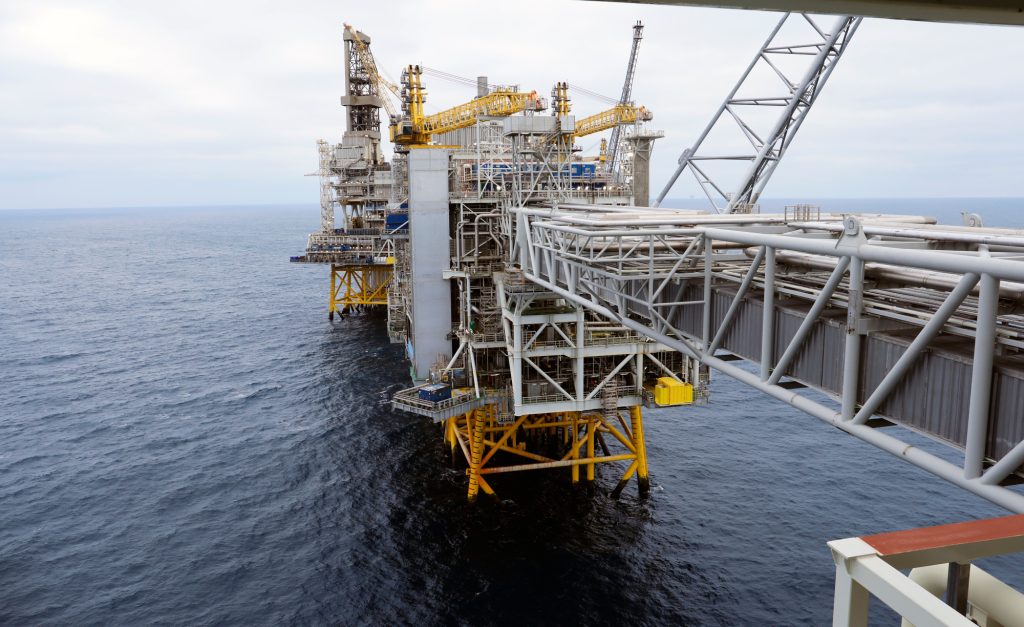
(Photo: Johan Sverdrup field centre in the North Sea/Equinor)