The 2026 edition of the annual World Economic Forum in Davos may have been dominated by US president Donald Trump’s geopolitical concerns, but there was another big theme – the continuing rise of artificial intelligence (AI) as a force for global economic growth.
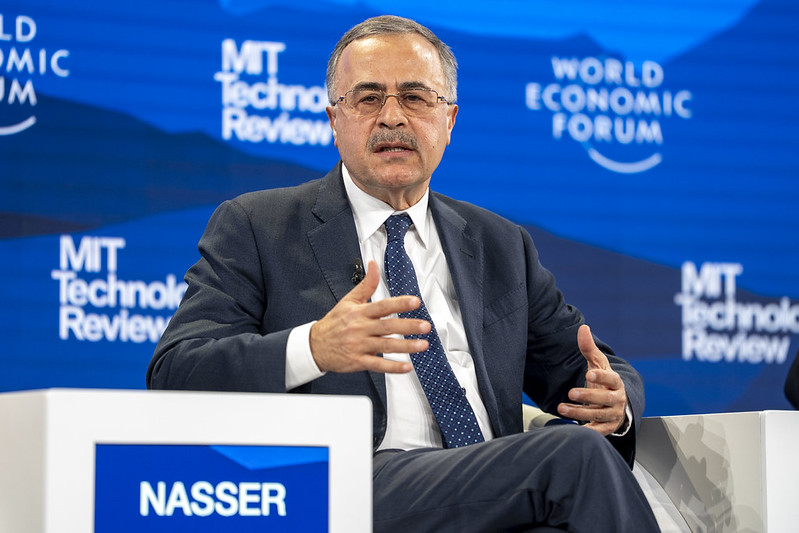
The growing impact of AI on operations in the hydrocarbons industry was highlighted by Amin Nasser, CEO of Aramco, Saudi Arabia’s state oil company. He told a Davos panel that he expected to his company to show significant AI-driven financial gains, when it’s 2025 results are released in February, due to productivity increases at its wells and falling drilling and maintenance costs.
Nasser said the number of applications of AI developed by Aramco continued to increase and their impact was being seen widely.
“Last year I talked about 400 use cases that we came up with in Saudi Aramco. This year, we’re talking about 500 use cases – a hundred use cases went from pilots to actual deployments,” he told the forum.
Nasser said preliminary figures indicate that Aramco’s investments in artificial intelligence and advanced technologies had generated $3bn-$5bn in realized value in 2025, compared to $6bn in 2023-24. Prior to that, the figure was more typically around $300m a year.
He said the energy sector needed to become more intelligent in the way it capitalised on AI, and that Aramco’s expanding in-house skills and its infrastructure built up over decades, made it well positioned in this regard.
Aramco has committed to training more than 6,000 AI developers in collaboration with institutions such as Imperial College, Caltech, and KAUST.
Nasser stressed the key role of high-level data quality in successful AI deployment and Aramco’s long track record in amassing geological and operational data, which could now be used to improve AI models.
“Our goal is to make the energy industry smarter through AI,” he said. “The most important thing in all of this is data quality. It’s garbage in, garbage out, if you don’t have the data quality. And we have built data quality over 90 years.”
Nasser highlighted progress made in the deployment of AI to enhance maintenance operations and improve reliability, citing one example that had allowed Aramco to reduce spending on anti-corrosion materials in pipelines due to improved analysis of asset performance driven by AI tools.
Partnerships
In recent months, Aramco has forged a series of partnerships with international tech companies designed to bolster its AI capabilities, such as a tie-up with AI-driven analytics company Cloudera announced in mid-2025. In October, Aramco acquired what it called a significant minority stake” in Humain, Saudi Arabia’s main AI company which was set up by the country’s Public Investment Fund.
Humain is intended to be the main vehicle for build out of the Saudi Arabia’s next-generation AI data centres, cloud services, advanced AI models, and applications.
In Davos, Humain and Saudi Arabia’s National Infrastructure Fund (Infra) announced a strategic financing framework agreement of up to $1.2bn to support the expansion of AI and digital infrastructure projects.
The pact paves the way for development by Humain of up to 250 megawatts of hyperscale AI data centre capacity, which the partners said would deploy leading edge GPUs to train AI and support Humain’s local and international customers. Infra and Humain said they would also look at establishing an AI data centre investment platform, structured to facilitate participation by global and local institutional investors in support of Humain’s AI strategy.
(Photo: courtesy World Economic Forum)