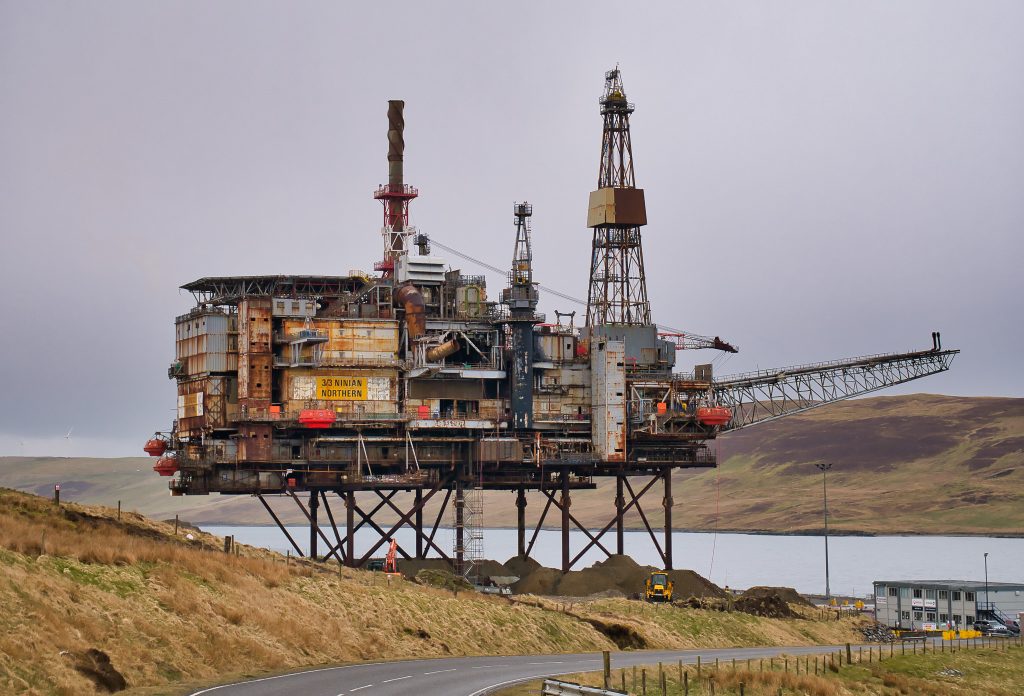
Artificial intelligence is not just benefitting the energy industry by boosting production output and efficiency, it also promises to be a valuable tool when facilities reach the end of their lives – a use case whose potential UK researchers are seeking to realise.
The Aberdeen-based National Subsea Centre (NSC) said it is developing a subsea decommissioning optimisation software demonstrator with marine industry logistics firm PlanSea. The research is being funded by a grant from the Scottish Funding Council in partnership with Scottish Enterprise.
NSC, which focuses on subsea research and technology development, opened in early 2023. It is the product of a partnership between Robert Gordon University (RGU) and the Net Zero Technology Centre (NZTC), both also based in the city.
By combining NZTC’s industry network with RGU’s academic and research capabilities, NSC seeks to develop smart digital and engineering technologies to support the energy transition in the North Sea and further afield. PlanSea is a spin out from RGU, formed in 2017, which holds the licence for the marine logistics AI tech developed by the university.
This new project is intended to develop a robust task-based formalisation of offshore decommissioning activities that will give decision-makers the ability to simulate the cause-effect relationship between different strategies and KPIs with a high degree of accuracy. The organisations say they are planning to produce an AI tool that will be ready for initial trials in the second quarter of 2025.
NSC said that, with global operators facing the challenges of large-scale and complex subsea decommissioning, the need was growing for optimisation in this area to secure a cost-effective and resource-efficient outcome, while also contributing to net zero targets by reducing emissions. The centre noted that the UK alone is expected to spend £21bn ($26.5bn) on decommissioning over the next ten years.
Professor James Njuguna, Director of Research & Innovation at NSC, said he was confident the project would harness NSC’s research expertise and PlanSea’s cutting-edge industrial knowledge to deliver a pioneering solution for the energy transition.
“Our in-depth knowledge of marine operations offers a great opportunity to collaborate with PlanSea to provide operators with substantial savings and reduce emissions,” he said.
Jim Cargill, PlanSea’s CEO, said the AI demonstrator would be aimed at addressing both standalone and collaborative campaign optimisation of current and future decommissioning.
Further UK initiatives
In August, NSC said it had formed a partnership with NOC Innovations, based in Southampton on the south coast of England, which makes marine research and autonomous technology available to organisations around the world. NOC Innovations is part of the National Oceanography Centre.
The partnership forms a community of researchers, engineers and scientists to deliver solutions addressing marine-related issues and sustainability and energy transition targets. It will draw on expertise in marine science, robotics, sensors and instrumentation, data science, artificial intelligence, imaging, object detection and classification, digital twins, simulation and remote sensing.
Another initiative to tap UK AI and tech expertise was announced in November, in the shape of the launch of the second round of a government-backed competition to strengthen the UK’s drive to become a clean energy superpower aided by AI.
The Manchester Prize was launched in December 2023 by the government in partnership with Challenge Works. Round 1, which focuses on energy, environment, and infrastructure, is due to finish in April next year.
Round 2 is focused on innovations using AI in clean energy systems that help boost low-cost energy, reduce energy demand and make energy use more efficient across the country. These could include, for example, new ways of increasing power generated by wind and solar farms, using AI to increase energy efficiency in homes and businesses, or using AI to build up a better understanding of spikes in energy demand, the government said.
The UK government will back up to 10 innovators with £100,000, before one winner from these finalists will secure a further £1m prize to support their innovation.
The deadline for Round 2 applications is 17 January 2025. The competition can also include solutions from around the world that partner with a lead UK-based organisation.
(Photo: Oil platform decommissioning in the Shetland Isles/Shutterstock)