
Plants do not fail in dashboards, they fail in metal. Yet many digital twin programmes still know more about how an asset was designed and how it is operating than what the latest inspection found. A twin may contain engineering data, process conditions, maintenance history, and a detailed 3D model, while missing one of the most important questions in asset integrity: what does the inspection evidence say about the physical condition of this component?
In refineries, petrochemical plants, gas facilities, and other asset-intensive operations, non-destructive testing (NDT) provides direct evidence of physical condition. Radiographic images, ultrasonic readings, wall thickness measurements, inspection reports, and certificates reveal what is happening in the metal – not what a model assumes should be happening.
When that evidence is scattered across PDFs, spreadsheets, shared drives, contractor systems, and instrument-specific software, the digital twin can be visually impressive but operationally incomplete.
From asset data to asset evidence
Most industrial data architectures are good at storing records. They are less effective at preserving the relationship between a result and the evidence behind it.
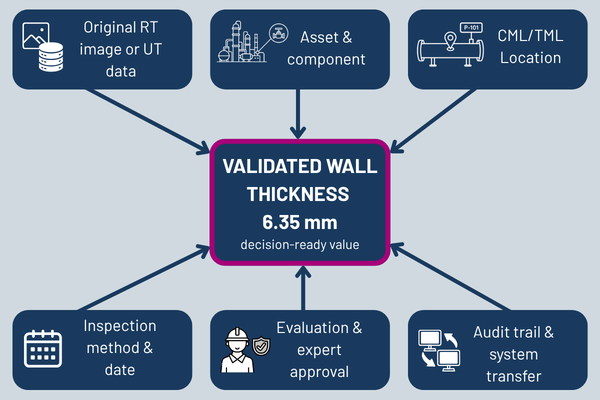
Consider a single wall thickness value. By itself, it is just a number. To support an integrity decision, the user also needs to know which component it belongs to, which condition monitoring location (CML) or test measurement location (TML) was inspected, when the measurement was taken, which method was used, who performed and reviewed the inspection, what the source image or instrument data shows, and whether the value has been validated.
Remove that context and the number may still look precise, but it is no longer trustworthy.
This is the distinction between asset data and asset evidence. Asset data can populate a dashboard. Asset evidence can support a decision, survive an audit, and be traced back to its source.
For digital twins to contribute meaningfully to asset integrity, risk-based inspection (RBI), maintenance, and turnaround execution, inspection evidence has to become part of the architecture – not an attachment added later.
What makes a wall thickness value trustworthy?
Why AI raises the standard
Artificial intelligence makes this requirement more urgent.
AI can reduce repetitive evaluation work, identify patterns across large inspection datasets, and make results available faster. But in safety-critical environments, the value of automation depends on more than model accuracy. The process must remain explainable and reviewable.
A useful example is the automated evaluation of radiographic wall thickness measurements. Instead of asking an expert to manually process every image and re-enter each result, AI can support the evaluation of radiographic testing (RT) images and generate structured wall thickness data. The expert remains in control of validation, while the system preserves the relationship between the original image, the evaluation, the component, the monitoring location, and the approval status.
DIMATE AI Automated Wall Thickness Evaluation is designed around this principle. Once the result has been reviewed and validated, CML and TML data can be transmitted directly to an inspection data management system (IDMS), Asset Integrity Management System (AIMS), RBI application, or digital twin. That eliminates a familiar break in the workflow: the point where a result leaves the inspection environment and is manually copied into the system used for integrity decisions.
This is where AI creates operational value. Not as a stand-alone algorithm, but as part of a controlled workflow that connects evidence, expert judgment, and downstream action.
The hidden cost of manual handovers
Manual handovers remain common because each individual step appears manageable. A contractor delivers a report. An inspector checks a spreadsheet. A corrosion engineer enters a value into the IDMS. A turnaround team stores images in a project folder.
The cost becomes visible only when the entire chain is examined. Engineers search for source files. Inspectors reconcile naming conventions. Data is entered more than once. Questions go back to contractors because the component or monitoring location is unclear. Reports and measurements become separated from the original images. At the next inspection, teams reconstruct the history again.
These are not only administrative inefficiencies. They affect the speed and confidence of integrity decisions.
During a turnaround, the delay between inspection, evaluation, approval, and repair can influence the critical path. During on-stream inspection, incomplete or late wall thickness data can slow corrosion assessment and inspection planning. Across multiple sites, inconsistent formats make it difficult to establish common standards or scale AI applications.
The answer is not another isolated system. It is a connected inspection workflow. In a connected workflow, NDT data, source evidence, review status and approvals remain linked from inspection through to the integrity system. This reduces manual re-entry, preserves the context behind each result and gives integrity teams traceable information when decisions need to be made.
A practical architecture for trusted inspection data
A useful inspection evidence layer should do four things.
First, it should capture original NDT data in a structured, vendor-neutral environment. Images, measurements, reports, and related documents should remain connected.
Second, it should organize the information around the asset. The component, weld, circuit, CML, or TML must provide the context – not the folder name or the contractor’s report number.
Third, it should support controlled evaluation and approval. Whether a result is produced manually, with AI assistance, or through a connected ultrasonic testing (UT) workflow, the review status and audit trail must be clear.
Fourth, it should exchange validated results with the systems that run the integrity process. IDMS, AIMS, RBI, maintenance, and digital twin platforms should receive structured information without forcing users to retype it.
This approach does not require operators to replace their existing integrity platforms. It strengthens them by improving the quality, traceability, and timeliness of the inspection data they receive.
From inspection evidence to integrity decision
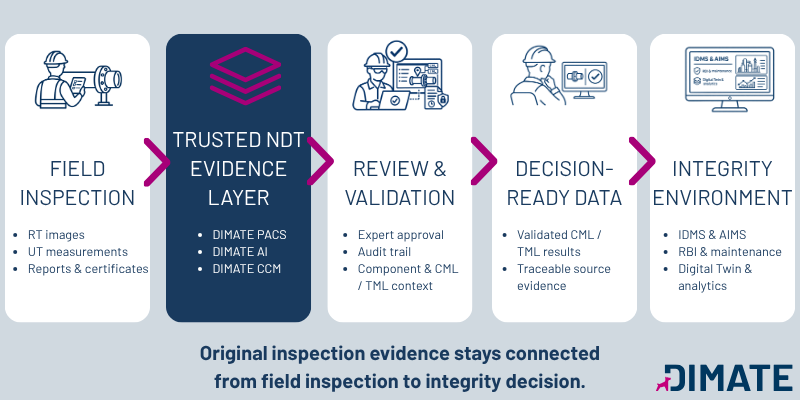
Figure 2: A connected inspection workflow keeps the original evidence, AI-assisted evaluation, component context, expert validation, and downstream integrity decision linked.
Lessons from medical imaging
The underlying concept is not new. Healthcare solved a similar problem years ago.
Medical PACS environments were designed to keep images, findings, patient context, and clinical workflows connected. The image was not treated as a loose file. It was part of a controlled information chain that supported diagnosis and long-term comparison.
DIMATE was founded by a team with roots in medical imaging and adapted this PACS logic to industrial NDT. DIMATE PACS manages inspection data and workflows, while DIMATE CCM brings NDT data together with reports, drawings, certificates, and other component documentation to create a digital component lifecycle file.The objective is not to turn a refinery into a hospital. It is to apply a proven information principle: critical decisions require source evidence, context, and traceability in one connected workflow.
Start with the decision, not the twin
For operators, the practical starting point is not “build a digital twin”. It is a specific integrity decision that is slowed down by fragmented information.
Where does wall thickness data wait for manual entry? Which results are difficult to trace back to source evidence? Where do contractors hand over documents instead of usable data? Which CML or TML workflows create repeated reconciliation work? Which AI use case cannot scale because the data is inconsistent?
Answering those questions reveals where the inspection evidence layer should begin.
A focused implementation may start with RT wall thickness evaluation, a UT measurement workflow, a corrosion circuit, or one turnaround. Once the data model, review process, and interfaces are established, the same approach can extend across methods, assets, contractors, and sites.
That is how digital twin and AI programmes move from pilots to dependable operating capability: not by adding more visualisation, but by improving the evidence that decisions are built on.
The test of a trustworthy twin
There is a simple test for any asset integrity digital twin.
Select a critical component. Can the user see the latest validated condition data? Can that value be traced to the original inspection evidence? Is the component and monitoring location unambiguous? Is the review status visible? Can the information flow directly into the next integrity decision?
If the answer is no, the twin still has a blind spot.
Closing that blind spot makes existing systems more useful, AI more accountable, and integrity decisions faster to defend.
A digital twin should not only show the asset. It should show why the organisation trusts what it knows about the asset.
About the author

Peter Rosiepen is CEO and co-founder of DIMATE GmbH, a German software company specialising in digital NDT workflows. With roots in medical imaging and PACS, he has helped transfer structured image, evidence, and workflow management principles to industrial inspection. DIMATE supports asset-intensive organizations in connecting NDT data with Asset Integrity, RBI, maintenance, contractor, and digital twin processes. His focus is making inspection data traceable, decision-ready, and suitable for responsible AI automation.
(Main photo: DIMATE/AI-generated)