The industrial metaverse is an innovative development that promises to transform the way industries interact with people, assets, processes, and objects. Unlike traditional enterprise systems that operate in one dimension, the industrial metaverse enables real-time collaboration in an immersive environment. As a result, businesses can benefit from enhanced communication, streamlined workflows, and improved decision-making in immersive contexts. This article explores how the oil and gas industry can leverage the metaverse for design review and collaboration, project progress review, immersive training, and remote monitoring and maintenance. It is important to note that at this stage, the metaverse acts as a digital twin for many assets developed at the corporate level and will not be a public metaverse.
- The metaverse enables oil and gas companies to conduct design reviews and collaborate in a virtual environment. Engineers and stakeholders can interact with 3D/4D/5D models, simulations, and data to identify potential issues, optimize designs, and make informed decisions. By allowing real-time collaboration among geographically dispersed teams, the metaverse reduces time spent on revisions and enhances overall design quality. The metaverse also serves as a digital twin for assets, allowing companies to create accurate virtual representations of their physical equipment and facilities before building them.
- With the industrial metaverse, project progress reviews become more engaging and accurate. Stakeholders can virtually visit project sites, review work progress, and address issues in real-time. The metaverse also offers the ability to overlay project timelines, advanced work packages, data, and key performance indicators, allowing teams to track progress more effectively and make data-driven decisions. In this context, the metaverse’s digital twin capabilities provide a comprehensive view of ongoing projects and their impact on corporate plans.
- Immersive training through the metaverse can revolutionize workforce development in the oil and gas industry. By leveraging virtual reality (VR) and augmented reality (AR) technologies, employees can undergo realistic training scenarios, safely practice complex procedures, and develop skills in a controlled environment. This hands-on approach to training not only accelerates learning but also reduces the risks associated with on-site training.
- The industrial metaverse can enhance remote monitoring and maintenance in the oil and gas sector by integrating IoT devices, sensors, and real-time data. Through the metaverse, engineers can access a virtual replica of assets and equipment, allowing them to troubleshoot issues, perform maintenance, and monitor performance from any location. This approach reduces the need for on-site visits, increases operational efficiency, and minimizes downtime. The digital twin functionality also allows companies to test and validate new maintenance strategies before implementing them in the physical world.
Digital Senses
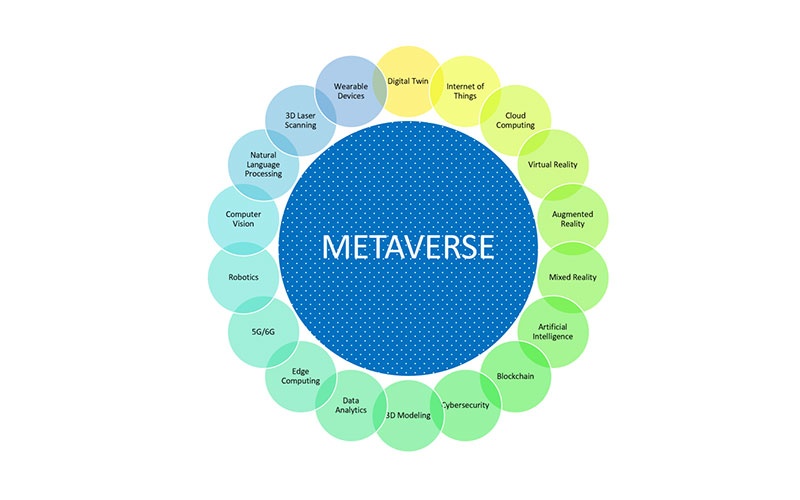
The industrial metaverse is not merely a single technology; rather, it represents an integrated ecosystem where various emerging technologies converge to deliver an immersive, real-time experience involving individuals, objects, and facilities. “Digital technologies for an asset or facility can be compared to human senses in that they serve as crucial means to collect, process, and interpret information from the surrounding environment, ultimately helping to improve integrated operations. Just as human senses work in harmony to provide a comprehensive understanding of our environment, digital technologies should be seamlessly integrated to interact and exchange information for optimal results.” Said Wassim Ghadban
The Industrial Metaverse is a digital ecosystem that integrates advanced technologies like Digital Twin, virtual reality, augmented reality, artificial intelligence, and IoT to create interconnected, immersive, and collaborative virtual spaces for industries. This transformative platform enables businesses to simulate real-world scenarios, optimize processes, enhance collaboration, and streamline supply chain management. It fosters innovation, reduces operational costs, and increases productivity, empowering companies to thrive in the rapidly evolving digital landscape