The effects of rising electricity demand from data centres may be the main focus of the International Energy Agency’s recent update on how AI is impacting the energy sector, but another interesting aspect is how smaller, more powerful and more energy efficient processors are propelling significant advances in the industry.
A case in point is the rapid development of physical AI – the technology that allows autonomous machines to perceive, understand, and perform complex actions in the real world, powering autonomous cars, industrial robots, drones, and smart sensors.
“With increasing deployment of AI-enabled robotics, automation and efficiency solutions, AI will be critical to industrial competitiveness,” the IEA says in the Key Questions on Energy and AI 2026 report.
It also estimates that AI-enabled optimisation of production processes could reduce energy costs by 3-10 percentage points in energy-intensive industries, while well-documented AI use cases could potentially save more than 13 exajoules (of energy by 2035, equivalent to 3% of global final energy consumption, if barriers to wider uptake can be surmounted.
The energy industry has been moving towards greater automation of processes for some time, leveraging the capabilities of digital twins and other technologies. However, the use of autonomous robots has yet to become widespread, in part due to concerns over safety and the high price.
Improving performance and falling costs of the high-end processing power required could alter that. The IEA says that, while robot deployment in general has largely stagnated in recent years, the rise of physical AI and a step change in capabilities could alter this trend, with investor interest already rising and the number of robotics and AI patents surging.
That possibility is reinforced by a recently published global survey of senior executives across 15 industries by Capgemini, which reported that over two-thirds of executives saw physical AI as game-changing, by enabling robots to interpret context, adapt in real time, and operate in unstructured environments.
Nearly eight in ten organizations said they were already engaging with physical AI today, which Capgemini said signalled strong momentum from experimentation towards deployment. Other key findings include the need to offset labour shortages in pushing adoption forward, and the belief that physical AI would make previously impractical use cases viable, expanding impact across productivity, resilience, safety and growth.
The hydrocarbons industry is already benefitting from the use of semi-autonomous technology, such as drones and underwater vehicles with AI-driven robotic capabilities. But is likely to remain cautious over ceding total control of decision-making on costly rig or refinery infrastructure to an independent robot.
Solar farm robots
Not all robotics applications are complex and there are examples of applications in the energy sector, where the risks are fewer, the costs lower and the benefits easier to reap.
One area where robots are starting to make a significant impact is the solar energy sector, where pioneers are showing how machines with a degree of autonomy can help speed up the development of solar farms, reducing strains on personnel in a labour-intensive industry.
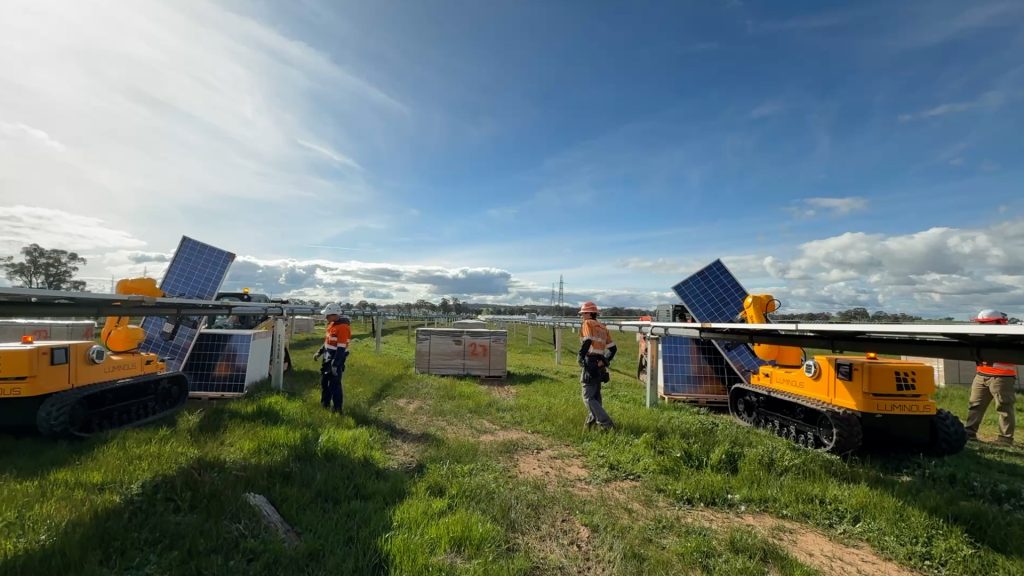
Several solar developers around the world are now working with autonomous robots that can select, lift and install photovoltaic modules into the correct position on their racks, speeding up installation, and allowing the accompanying workforce to cut down on heavy labour and focus on other more technical tasks.
The huge scale of some solar farms, spread across land that is often flat and relatively featureless, make them an ideal environment to deploy robots at this relatively early stage of physical AI development.
Maximo, a solar robotics company backed by AES, said in March it had successfully used autonomous robots to instal 100 megawatts (MW) of utility-scale solar capacity at AES’ Bellefield site in California. Maximo said that four of its robotics units operating in parallel with each other and working alongside crews, had installed up to 24 modules per shift hour per person, nearly double the output of traditional installation methods in the region.
In Australia, another country rapidly expanding solar capacity, four robots from US firm Luminous Robotics have been doing a similar job at Engie’s 250 MW Goorambat East solar farm near Melbourne, where they have helped to install the farm’s almost 600,000 panels.The use of physical AI in projects like these is still a long way from the point where the humans can take the day off and leave it to the machines, but they could be an important early step on reaching it.
(Photo: Robots installing panels at the Goorambat East solar farm | Luminous Robotics)