The potential for the escalating power requirements of AI-driven technology to drive up global carbon emissions has been much debated over recent months, somewhat eclipsing the positive impact AI is likely to have in improving energy efficiency and cutting emissions elsewhere in our lives.
New research from the Grantham Research Institute on Climate Change and the Environment (GRI) at the London School of Economics aims to put the issue in perspective by quantifying possible savings in global greenhouse gas (GHG) emissions, as AI is applied in a number of “key impact areas” over coming years – and the authors have come up with figures that suggest these emissions reductions could “outweigh increases from global power consumption of data centres and AI”.
In Green and Intelligent: The Role of AI in the Climate Transition, they say advances in AI applied to power, transport and food consumption could reduce global emissions of greenhouse gases by 3.2bn-5.4bn tonnes of carbon-dioxide-equivalent (GtCO2e) annually by 2035. That compares with estimated emissions increases resulting from power demand from data centres and other AI applications in the 0.4bn–1.6bn GtCO2e range, with that rise derived in part from increased use of gas-fired power to complement renewables. The researchers note that their estimations of power consumption are based on an assessment of all AI activities, not just those related to decarbonisation.
The research team was headed by Nicholas Stern, Chair of the GRI institute, who produced the influential Stern Review on the economics of climate change 20 years ago. He said AI could be leveraged as a driver and catalyst to accelerate cuts in greenhouse gas emissions and the transition away from fossil fuels, but that leaving markets alone to determine the applications and governance of AI could be risky.
“Artificial Intelligence holds transformative potential to accelerate the climate transition in emerging and developing economies — helping to unlock investment, reduce risk, and leapfrog outdated infrastructure — yet realizing this promise requires targeted public investment, shared data, and equitable access to AI capabilities so that no country is left behind in the net-zero transition,” Stern said.
The report focuses on five impact areas where AI drives emissions reductions. A study of these provides “a clear roadmap for harnessing AI’s potential”, according to the authors. The impact areas are: transforming complex systems, innovating technology discovery and resource efficiency, nudging and behavioural change, modelling climate systems and policy interventions, and managing resilience and adaptation.
The power, transport and food consumption sectors together are responsible for around 50% of global emissions of GHGs annually. The authors say these sectors are highly interconnected so accelerated adoption and efficiency of low-carbon solutions in one area would likely trigger “technological tipping points” elsewhere, leading to “cascading effects across the economy”.
More efficient renewables
In the power sector, the research indicates that AI can improve the efficiency of renewable energy systems through improving grid management and increasing load factors of solar photovoltaic and wind energy by up to 20%.
AI could also improve adoption rates of alternative proteins (APs), which would help reduce emissions from the food sector. Estimates in the report for AP adoption rates range from 8-14% in a “business as usual” scenario to 18-33% in an “ambitious” AI scenario, and 27-50% in a “highly ambitious” AI scenario.
The report also looks at how AI can be used to support long-term resilience and adaptation to climate change.
AI offers the ability to create large-scale simulations that track how ecosystems might evolve, as well as improving forecasting of hazards, as the severity and frequency of climate-related disasters increase. The authors note that AI is already improving early warning systems for extreme weather events, such as floods and wildfires, enabling governments and communities to take proactive measures to save lives, minimise damage and mitigate costs.
Meanwhile, AI modelling can be applied to better design and implement policies for climate action by generating insights and predictions around complex climate policy scenarios and monitoring the effectiveness of policy implementation.
The report also looks at other areas where AI is can make a difference to business and livelihoods. For example, AI is enabling more sophisticated prediction of investment risks and returns, improving financial decision-making in regions where information is scarcer, particularly emerging markets where risks are often perceived as high due to the limited data available.
The GRI research echoes some of the findings of the International Energy Agency’s recently published Energy and AI report, which said the need to use natural gas to partner renewables to meet power demand from data centres would push up carbon emissions, even if the sector’s share of overall global emissions would remain relatively low. The IEA also highlighted the ability of AI to provide solutions to make the energy industry more efficient.
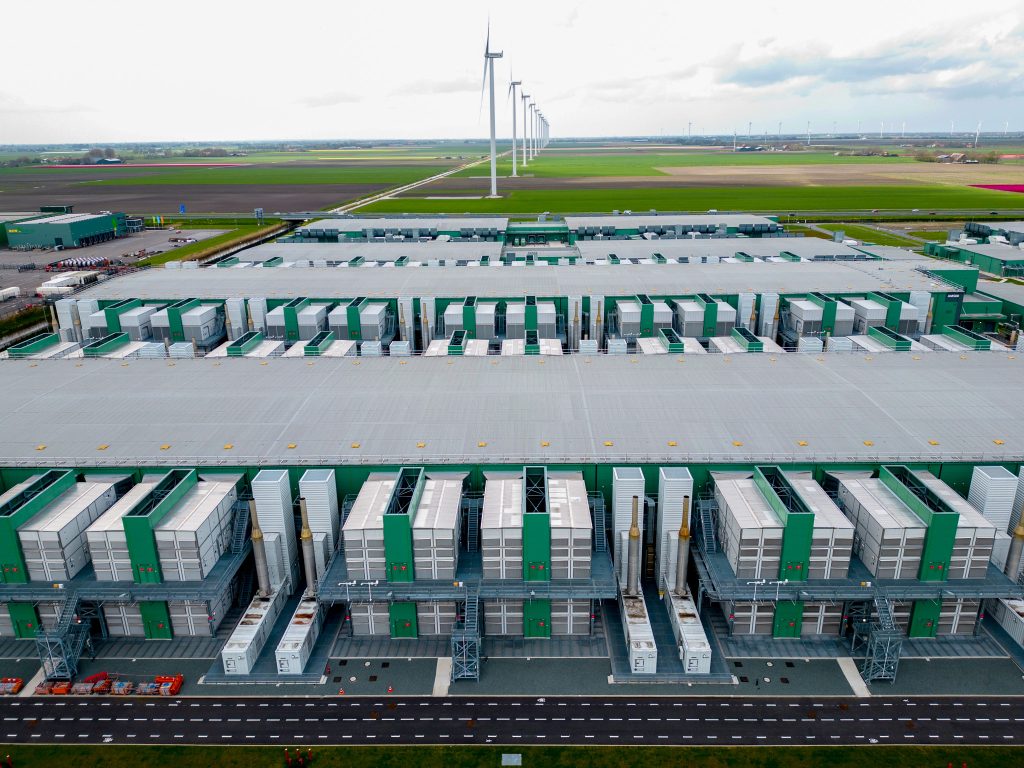
(Photo: Data centre in The Netherlands\Shutterstock)