
What happens when artificial intelligence can develop an idea faster than people can absorb it?
For teams exploring AI-assisted software development, this question is becoming increasingly practical. A discussion that begins with a business problem can quickly produce data models, processes, rules and interactive screens. An idea that once needed weeks of workshops and design work can take shape while the conversation is still happening.
That speed creates an opportunity. It also changes where the difficult work sits.
When AI can generate a detailed application concept in minutes, people still need to examine it. They need to understand the assumptions, challenge the decisions and judge whether the proposed solution solves the right problem.
This is one of the challenges being explored through the AI-assisted engineering environment TAAP Ideas: how to turn the speed of AI engineering into shared human understanding.
From conversation to application
Ideas begins with something familiar: a conversation about a problem, an opportunity or an idea.
Someone might describe a process that takes too long, information that is difficult to find, or a service that could work better. They do not necessarily arrive with a specification. Often, the conversation itself is how they discover what they need.
As that discussion develops, the AI engages with it, asking questions, challenging assumptions and progressively engineering the application behind the idea.
It models data and relationships. It generates representative data so the concept can be simulated. It defines processes, rules and behaviours. It also creates detailed, interactive screen mock-ups that allow participants to explore the proposed application.
The concept becomes something people can use and challenge in minutes, rather than weeks.
That distinction matters. Reading a requirement and experiencing its consequences are different activities. A sentence describing an approval process may sound reasonable. Walking through that process can reveal an unnecessary step, missing information or an exception nobody has considered.
An interactive application concept gives the conversation something concrete to work with. People can respond to what they see, test what they mean and refine their thinking.
More than a disposable prototype
The mock-ups have a purpose beyond demonstrating an idea. They become a semi-formal specification of the application: a representation that stakeholders can inspect, interact with, refine and agree before the software is built and deployed onto the TAAP Platform.
“Semi-formal” is significant here. The specification needs enough structure to support engineering, while remaining accessible to the people whose knowledge and decisions shape the application.
Behind the experience, Ideas connects requirements, decisions, processes, data, screens, components, behaviours and integrations.
Each connection helps explain how the solution fits together. A screen exists to support an activity. That activity depends on information. The information has relationships and rules. Those rules reflect decisions made during the discussion.
Existing TAAP components can be identified and assembled into the solution. Where a required capability does not exist, the gap can be identified, a new component generated and that component fed back into the application build process.
The result is an evolving body of engineering knowledge, with connections between what people need and how the application is intended to deliver it.
The new bottleneck
This creates another problem: cognitive load.
A relatively short discussion can expand into hundreds of interconnected requirements, decisions, entities, screens, components and relationships. Each item may be understandable in isolation. Together, they can become difficult to navigate.
The challenge therefore extends beyond whether AI can capture and engineer a solution. It includes whether people can understand everything the AI has captured.
More documentation does not automatically provide more clarity. A comprehensive specification can still leave participants struggling to find the decisions that matter to them or understand the consequences of a proposed change.
Different people also need different routes through the same material. A business user may want to follow a process. A data specialist may need to inspect relationships. A developer may need to understand dependencies.
All are examining the same application, but through different questions.
Making complexity explorable
One experiment within TAAP Ideas is a live hyperbolic view of the evolving problem and solution space.
The aim is to let participants explore an area in detail while retaining a sense of its wider connections. Rather than requiring everyone to work through the specification in the same order, the view provides routes into the application according to each person’s expertise.
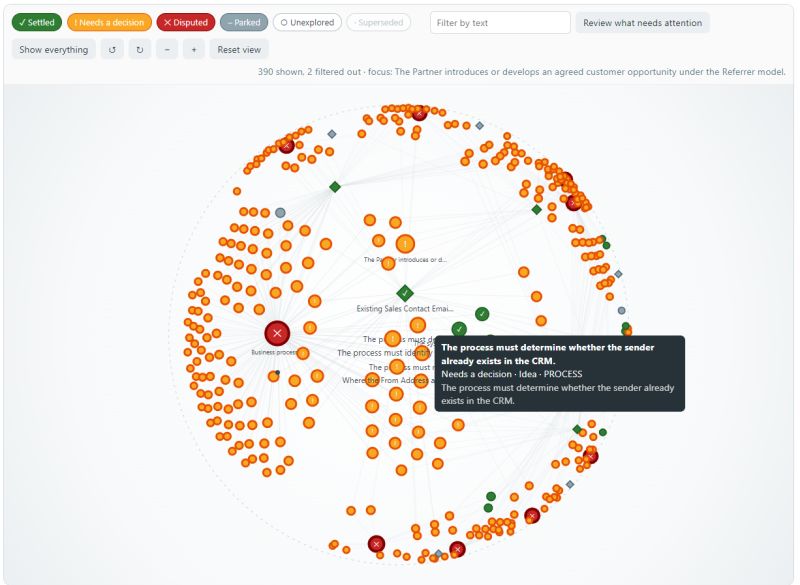
Business users can follow requirements and processes. Data specialists can explore entities and relationships. UX teams can examine screens and interactions. Developers can inspect components and dependencies.
For decision-makers, the view can surface what is settled, disputed, parked, unexplored or still awaiting a decision.
That status matters as much as the content. A polished screen can make an unresolved assumption look final. Making uncertainty visible helps participants distinguish between what has been agreed and what still needs attention.
The goal is to make complexity explorable, so people can investigate the parts they understand and see where those parts connect to the rest.
A conversation that continues
Conversational AI remains alongside that visual exploration.
Participants can ask: What haven’t we agreed? What does this decision affect? Which screens use this data? Show me how this process works. Simulate it. Change it and show me the impact.
These questions turn inspection into an active process. Someone can move from noticing an issue to examining its consequences, then testing a possible alternative.
The quality of that exchange remains crucial. Fast generation does not establish that an assumption is correct or that stakeholders agree. People still bring operational experience, priorities and judgement. The emerging application gives them something specific against which to apply that knowledge.
Engineering at the speed of understanding
AI-assisted development is increasing the speed at which teams can create engineering knowledge and intellectual property, as well as software.
The next challenge is helping people explore, understand, challenge and agree that knowledge as it grows.
For TAAP Ideas, that means treating human understanding as part of the development process itself. The conversation produces an application concept; exploring that concept produces better questions; those questions improve the engineering.
The ambition is a continuous path from conversation to understanding, from understanding to engineering, and from engineering to working software.
Think. Build. Run.
About the author
Steve Higgon has been developing large complex distributed real-time systems for more than 40 years, during which time implementation (coding) has ceased to be the major bottleneck it once was. Steve created TAAP Ideas to shift the effort from implementation to ideation, putting humans eye to eye and toe to toe with AI. He is a regular contributor to Future Oil & Gas and Future FDT & AI conferences.
(Main photo: TAAP)