Many conversations about AI in energy start with the wrong question. Leaders ask what the technology can do, but the question that defines the winners is whether the organisation is ready to use it.
I heard the clearest version of this at ONS this year, in a session with Oddgeir Dalane, SVP Project Development at Vår Energi. He named three excuses that stop collaboration on data (and by extension, stop AI from being useful):
1. My data is not good enough
2. Our standards don’t match
3. This is my data, and I don’t want to share it
The first two are engineering problems with engineering answers. An open, agnostic platform with proper governance and lineage solves the data question – and physics-based simulation fills the remaining gaps where instrumentation is limited. A knowledge graph that maps tags and asset names lets systems talk to each other. Solvable, and largely solved.
The third excuse is not a technology problem at all. It is about openness and courage – the human half of readiness that actually decides outcomes.
Readiness compounds
At a strategically important offshore gas field-onshore gas processing complex, a digital twin built on the Falkor platform enabled a complete change in how people worked: fewer physical maintenance walks, engineers who could be offsite to confirm what the data already showed them, and less time searching for information. Here, an independent assessment by S&P Global Energy* found maintenance tool time (the actual proportion of a shift spent doing the job rather than finding the information needed to do it) rose from around 45% to over 80%.
Why was this possible? Because the organisation adopted a system. But more so – they were ready to change existing ways of working and had spent time building the trust and workflows needed to transform change into habits.
Lessons from an industry adjacent to oil and gas
I heard the same pattern from an industry with even less room for error. Fernanda Lopes Larsen, EVP Corporate Development at Yara, took the stage at ONS to describe the challenge of digitalising the Sluiskil and Porsgrunn sites. In an ammonia plant, and inside a company that is part of Europe’s food security infrastructure, failure means something different than it does for most technology rollouts.
Just like our industry, their bottleneck was not a lack of information. Decades of drawings, models, procedures and history existed. But it was scattered across systems and formats, and a great deal of it lived in people’s heads, undocumented, because operators simply knew what to do. That is an organisational problem, not a data one, which is precisely why the challenge is scale and not technology.
What leaders get wrong about workforce readiness
The leadership instinct is often to treat adoption as a training problem: teach people the new tool, and readiness follows. It rarely does. Fernanda was candid that people at Yara were worried about this long before the current AI boom: what does this replace? Why should I use it? I don’t have time for this. Ingesting and contextualising data into a digital twin was good but it had to be used, which meant designing with real empathy for the person on the other end.
Operators hate two things: the way something is, and change
Involving them early is not a nice-to-have. Fernanda shared that if they had it to do again, they would involve operators from the start rather than after the architecture was decided, because the answers to the hardest questions were on the shop floor the whole time.
Done correctly, the payoff is not marginal. Yara reported 70% faster resolution of plant startup and shutdown issues, a 50% improvement in engineering productivity, and 60% fewer unnecessary field trips, framed deliberately as a safety result rather than an efficiency one, since every trip not taken is a risk not taken.
The real test of readiness
Vår Energi’s experience adds something important here. Screening roughly 1,000 inspection findings in three hours, versus three or four a day manually, is a big number. However, Oddgeir’s strongest point on stage was about more than just speed. Engineers were able to spend their time on judgement and expertise instead of finding and structuring information.
That is the more useful test. Not whether AI makes the old process faster, because most will. It is whether the time that frees up gets reinvested in the work only your best people can do.
Where this leaves leaders
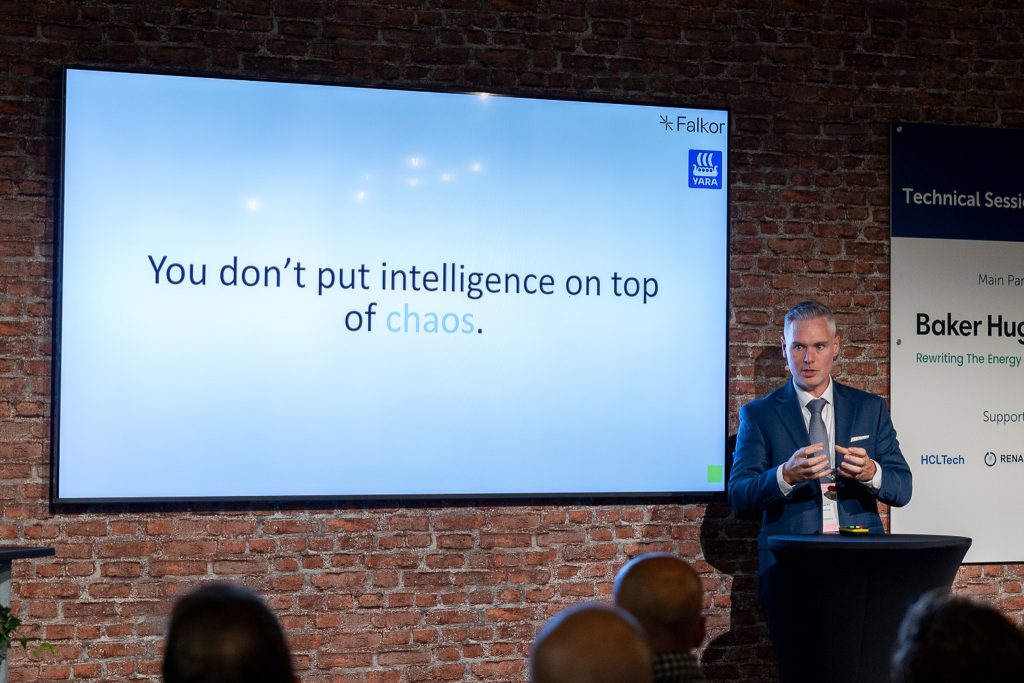
The strategic choice in front of most energy leaders right now is how to approach doing the unglamorous work first: consolidating data, mapping how people actually work instead of how procedures say they should, and being honest about which parts of the organisation are truly ready – and which are not. Skip that step, and you are putting intelligence on top of chaos.
Oddgeir closed his session at ONS with a line I have not stopped repeating since, and so I will leave you with this: act when you can, not when you have to.
* Abbink, O. (2026). A most advanced digital twin: Optimizing gas production from reservoir to dispatch point. S&P Global Energy, Strategic Report, July 2026.
About the author
Shane McArdle is CEO and President of industrial intelligence platform developer Falkor, a KONGSBERG company that supports some of the world’s largest energy and industrial companies as they navigate digital transformation, AI adoption and the future of work. Shane holds a PhD from the University of Limerick and has spent more than a decade working alongside industry leaders to solve some of the sector’s most complex operational challenges.
(Main photo: Shane McArdle talks to the ONS Conference in Stavanger, August 2026 / Falkor)