

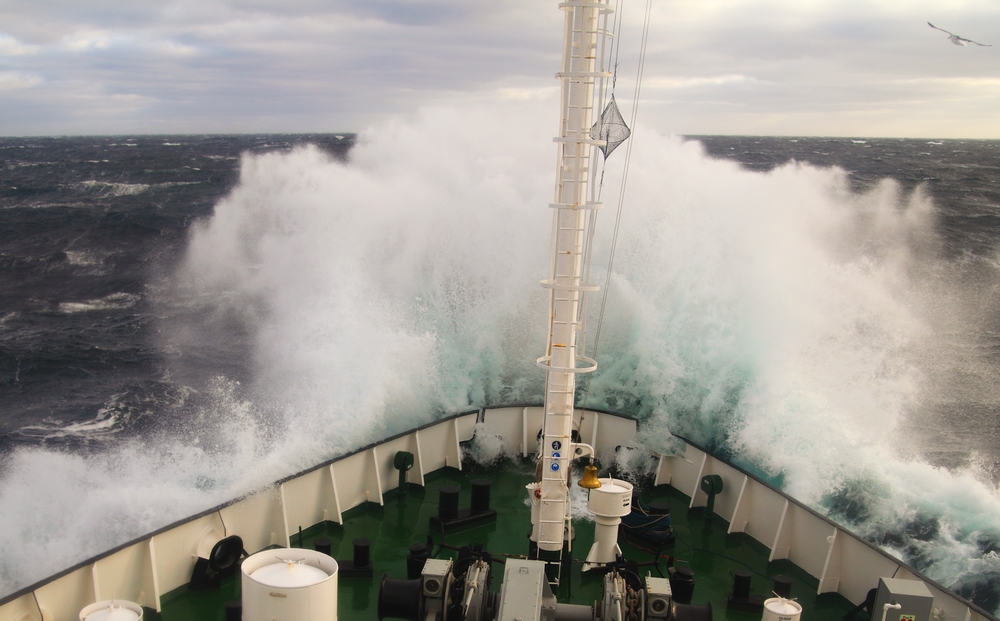
Creating order out of apparent chaos by making sense of complex data is a prime attribute of artificial intelligence-driven applications. But understanding the many variables of ocean movements and wave formation would seem to be at the most challenging end of the spectrum for AI developers.
However, it is a challenge that is being tackled, not least because understanding sea conditions is of considerable value to those exposed to the dangers of working in a marine environment, such as crews in the offshore hydrocarbons or wind sectors.
Norwegian-based Miros is one company that has come up with AI-supported technology that it says provides accurate real-time prediction of wave conditions that a vessel is likely to encounter a few minutes in advance, as well as calculating the vessel motion those waves are likely to produce.
That kind of warning allows the crew to avoid any activity that could be dangerous if rough conditions are on the way, Conversely, ir also allows them to get ready to load or offload cargo like pipeline infrastructure and ROVs, or make gangway transfers, if calmer conditions are predicted. Miros said in March that its wave monitoring technology had been fitted to two cable-laying vessels owned by Prysmian.
The AI technology, which Miros calls PredictifAI, works by using data from typical X-band radar deployed on vessels to scan the sea and build an image of conditions. This data is then analysed using AI to create its predictions.
Measuring ocean waves and currents for offshore industries is something the company has been doing since 1984, but the real-time predictions now available have only become possible with recent enhancements to AI and computer processing.
On launching PredictifAI, in late 2024, Gunnar Prytz, Miros’ CTO, said that when Miros was formed the idea of wave prediction would have seemed like science fiction.
“By combining AI with site-specific sea state measurements in real-time, we are giving vessel operators the power to see into the immediate future, enabling them to make informed decisions and manage critical operations with unprecedented confidence,” he said.
However smart the AI component may be, the technology is dependent on ensuring the raw data it processes is as comprehensive and accurate as possible. To that end, the company says collaboration with its early-adopter offshore customers was crucial to the development of PredictifAI, ahead of a wider rollout.
Oil spill warning
The company also uses its technology to provide one of several solutions on the market to detect oil spills. It has just announced an update that allows real-time information on spills to be shared rapidly between stakeholders via the cloud.
The underlying product allows its wave measurement technology to detect where areas of the sea are flatter than would be expected in the prevailing wind conditions – an indicator that oil may be lying across the surface. AI and other analytics are then deployed to assess the extent and seriousness of the spill.
(Photo: Shutterstock)