Industrial organisations have spent years investing in digital transformation. Engineering systems, asset management platforms, maintenance applications, reality capture, digital twins, and operational systems in general now contain enormous amounts of information about physical assets.
AI is creating even more opportunities to put that information to work.
But as organisations connect more systems, digitise more assets, and introduce increasingly intelligent technologies, one critical layer is still often missing: physical context.
Industrial operations exist in the physical world. Assets have locations, relationships, surrounding conditions, and dependencies. Yet the information used to understand and manage those operations is often fragmented across systems, teams, projects, and sites.
The next stage of enterprise digital transformation is not simply about creating more digital information. It is about giving that information a consistent connection to the physical operations it represents.
Connecting information to physical reality

In many organisations, engineering information may exist in one system, maintenance records in another, reality capture somewhere else, and operational information across additional applications. Each source provides value independently, but people are often left to make the connections between them.
Knowing that an asset exists in an enterprise system is useful. But understanding what that asset is, where it exists, what surrounds it, how it relates to other equipment, and what information is associated with it creates a much richer foundation for decision making.
This is the role of Visual Operations, or VisOps.
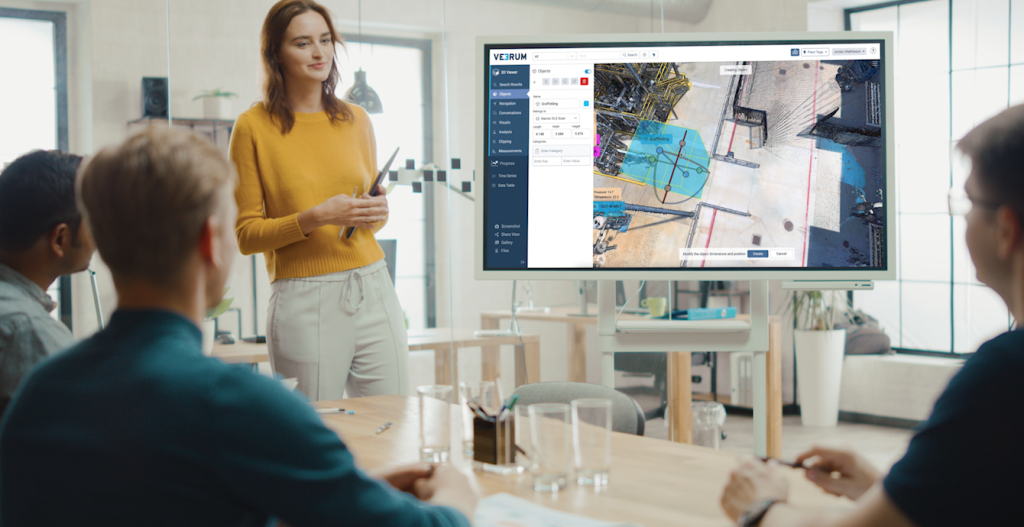
VEERUM pioneered the VisOps category to provide a visual foundation for industrial operations. VisOps connects the physical representation of every site with enterprise information, creating standardised spatial and asset context for how people and intelligent systems understand physical operations.
Rather than replacing the systems that organisations already rely on, VisOps connects them through the common context of the physical asset.
Moving to an enterprise standard
For many industrial organisations, digitisation has happened incrementally. A project commissions a laser scan. A facility captures 360-degree imagery. Another team develops a digital twin. Engineering, maintenance, projects, and operations each introduce systems designed to solve specific challenges.
These initiatives create value, but the challenge comes when organisations attempt to scale that value across an enterprise.
VisOps provides a standardised approach to how physical sites are digitally represented, accessed, and understood. Spatial and asset context can be established consistently across facilities while accommodating the systems and information already in place.
This also creates continuity across the asset lifecycle. Context developed during engineering, construction, or projects can remain available through handover, operations, maintenance, turnarounds, and future change.
Instead of repeatedly recreating context for individual projects and workflows, organisations can preserve and reuse it, turning digital reality into a scalable enterprise resource.
Building on existing digital investments
Creating better operational context does not require replacing technology investments already in place.
Industrial organisations have invested significantly in enterprise asset management, engineering systems, reality capture, operational applications, and other digital technologies. VisOps connects that information in a singular platform making it easier to access and understand across workflows.
Maintenance teams can remotely view equipment and surrounding conditions alongside relevant asset information before travelling to site. Engineering and project teams can verify the site against engineering drawings before planning and executing work. Turnaround teams can better understand equipment, access, work locations, and the physical environment before execution begins.
At enterprise scale, these capabilities support workforce productivity, capital efficiency, knowledge retention, cross-site visibility, risk awareness, and asset lifecycle optimisation. The same physical context can support multiple workflows, teams, and initiatives rather than being recreated each time a new use case emerges.
Physical context is becoming critical for AI

The emergence of enterprise AI makes this foundation even more important. AI is rapidly improving its ability to access information across applications and systems.
But access is not the same as understanding.
An AI system might retrieve a work order, inspection report, engineering document, or maintenance record. In an industrial environment, understanding that information also requires knowing how it relates to physical operations: Where is the work taking place? Which physical asset does the information relate to? What equipment is nearby? How do assets relate spatially?
For industrial AI, context cannot exist only within documents and databases. It must also be grounded in physical reality.
VisOps creates that grounding by establishing consistent spatial and asset relationships between physical sites and enterprise information. This provides a foundation for AI-assisted workflows that can understand not only what information is available, but what it represents within the physical operation.
As AI evolves toward increasingly agentic systems capable of interacting with multiple enterprise tools, the value of industrial AI will not only depend on how much information it can access, but on how effectively it understands the relationships within that information.
An operational foundation that scales
Digital twins, reality capture, connected data, automation, and AI will all play important roles in the future of industrial operations. Their enterprise value will depend on how effectively organisations connect these capabilities to each other and to the physical assets they represent.
VEERUM is leading this shift through Visual Operations, establishing a standardised way to connect physical sites with enterprise information and create spatial and asset context that can scale across sites, workflows, automation, and AI.
For industrial organisations, the opportunity is not simply to create more digital representations of physical assets. It is to establish a trusted foundation of physical context that can be accessed and reused across the enterprise.
When people, enterprise systems, and intelligent technologies share that context, digital information becomes more useful, existing investments deliver greater value, and emerging technologies have the grounding they need to support meaningful operational outcomes.
About the author

As VP of Business Development at visual operations platform developer VEERUM, Meaghan Snethlage works closely with clients and industry partners to utilise open architecture and data-centric solutions to navigate today’s complex and evolving industrial landscape. Meaghan’s expertise in client relations and understanding of the latest innovations makes her a key advocate for the transformation of asset management and visual operations.
(Main photo credit: VEERUM)