

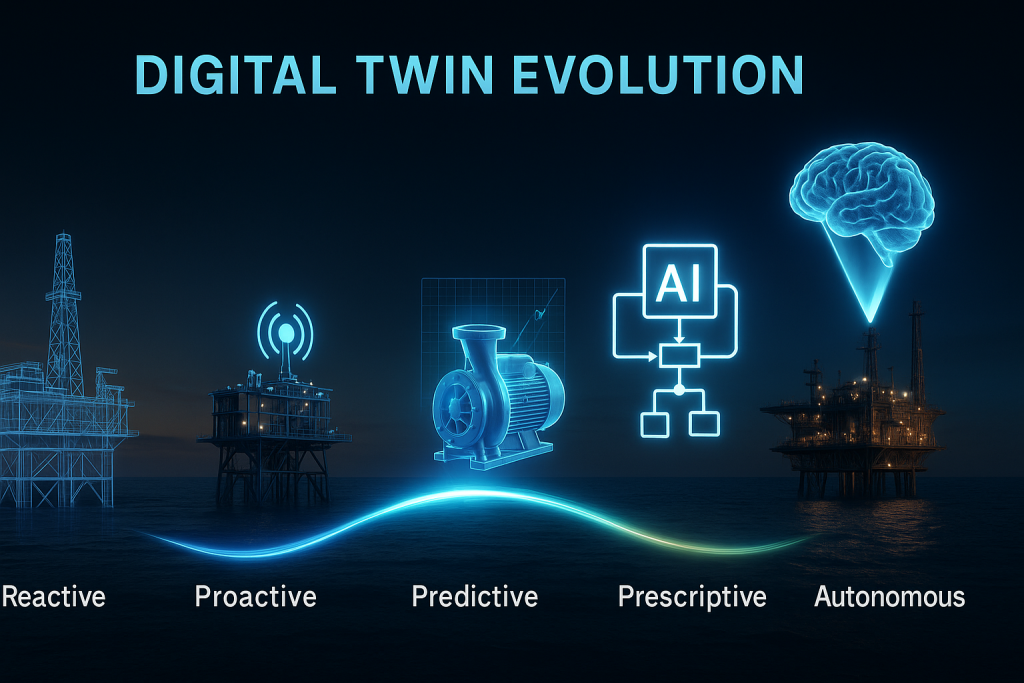
Over the past decade, Digital Twin solution has quietly matured from a static 3D replica into the operational “brain” of industrial assets in the energy sector. What began as a visualization tool has now evolved into a decision-making and action-executing intelligence layer powered by IIoT, AI, and agentic automation.
This evolution can be summarized in five distinct generations of capability.
1- Reactive Digital Twins
Question answered: “What happened?” Role: Visual monitoring
Early digital twins were primarily digital mirrors — a static or semi-static representation of the asset used for engineering visualization, audits, or post-event review. It has been used as well for desing review before execution, “walking inside the plant before you build it” using immersive technologies
Example: A refinery using a 3D model to verify maintenance access after an equipment failure.
Value delivered: Situational awareness, documentation, engineering reference.
2- Proactive Digital Twins
Question answered: “What might happen?” Role: Early detection
When IIoT sensors were integrated, the twin became data-aware, providing alarms and deviation alerts before a failure surfaced.
Example: Pipelines equipped with pressure/vibration sensors notifying engineers of abnormal conditions before a leak or rupture.
Value delivered: Condition-based maintenance and faster response.
3- Predictive Digital Twins
Question answered: “When and how will it happen?” Role: Forecasting
When AI/ML models and physics simulation were integrated, the twin gained the ability to forecast degradation and failure timelines, not just detect anomalies.
Example: Predicting compressor bearing failure weeks in advance using trend analysis and simulation.
Value delivered: Reduced downtime, improved planning, spare parts optimization.
4- Prescriptive Digital Twins
Question answered: “What should we do now?” Role: Decision support
This generation goes beyond prediction. It recommends the best corrective action, comparing cost, risk, and operational impact, transforming engineers from troubleshooters into decision evaluators.
Example: A petrochemical plant where the twin not only predicts a heat exchanger fouling event, but also recommends:
- whether to clean now or later
- the optimum operating window
- the best maintenance window aligned with production targets
Value delivered: Optimized OPEX, objective decision-making, faster interventions.
5 – Autonomous Digital Twins
Question answered: “Can it take action for me?” Role: Closed-loop autonomy
This is the frontier today: digital twins that execute the decision, not just recommend it. using agentic AI, autonomous workflows, and integration with control systems (DCS/SCADA).
Example: An offshore unmanned platform where the twin:
- Detects a deviation
- Simulates impact
- Chooses corrective action
- Adjusts the setpoint automatically
- Notifies the operator after execution
Value delivered: Single process autonomous or fully autonomous operations → safer, leaner, more resilient assets.
Why This Matters Now
Energy assets are becoming more remote, more complex, and more carbon-sensitive. The move to remote + autonomous operations is not just optional — it is becoming fundamental to cost, safety, and sustainability targets. Digital Twins are no longer a “digital engineering tool.” They are becoming the operational nervous system of the asset. Join us to discuss this evolution in abu Dhabi – Future Digital Twin & AI Middle East
Written by:
Wassim Ghadban
Global SVP, AI & Digital Engineering
FDT & AI MEA – Event Chairman