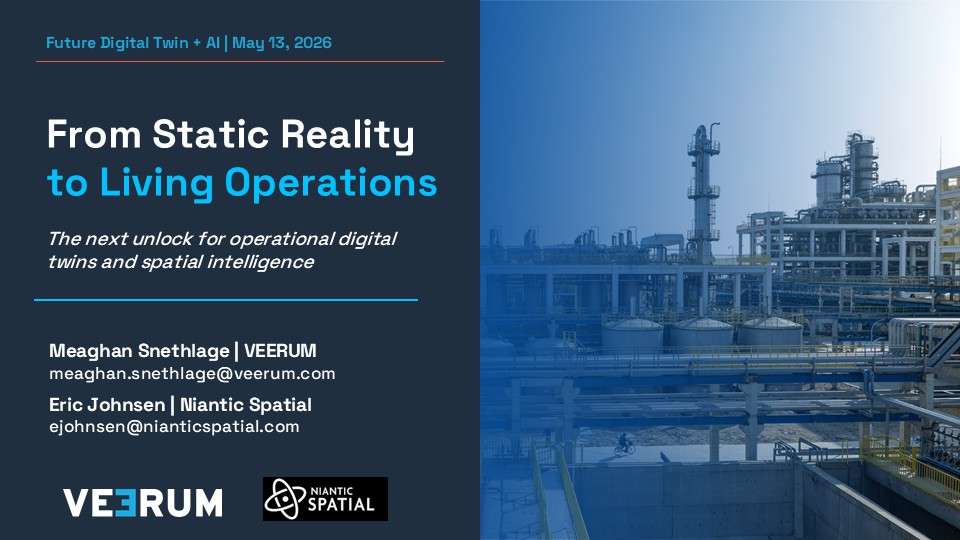
From Static Reality to Living Operations – The next unlock for operational digital twins and spatial intelligence
Meaghan Snethlage, VP of Business Development at VEERUM
As industrial operations move toward autonomy, the challenge is no longer capturing data, but making operational reality continuously accessible, contextual, and alive. Meaghan Snethlage, VP of Business Development at VEERUM, explores how spatial intelligence and operational digital twins are evolving from static representations into living operational environments that support AI-driven decision-making in real time.
The presentation highlights why spatial ground truth is becoming foundational for the next generation of industrial AI. From robotic inspection and AI-guided maintenance to autonomous drilling and closed-loop operations, VEERUM and Niantic Spatial demonstrate how future operational models depend on precise, continuously updating spatial context rather than fragmented and siloed data environments.
A major focus of the session is the industry maturity journey from visibility and analytics toward predictive intelligence and autonomous operations. VEERUM positions its VisOps platform as the operational consumption layer that transforms facility reality into an interactive operational interface supporting remote maintenance planning, engineering, shutdowns, turnarounds, safety, and brownfield or greenfield project execution. Combined with Niantic Spatial’s centimetre-level positioning and large geospatial model, the platform enables both people and machines to understand and navigate industrial environments with far greater operational awareness.
The presentation also explores the operational impact of continuously updating spatial intelligence, including reduced field exposure, lower rework, improved turnaround execution, and stronger alignment between field activity and operational systems. The message from VEERUM is clear: organisations that establish a live spatial intelligence foundation today will define the autonomous operating models of tomorrow.