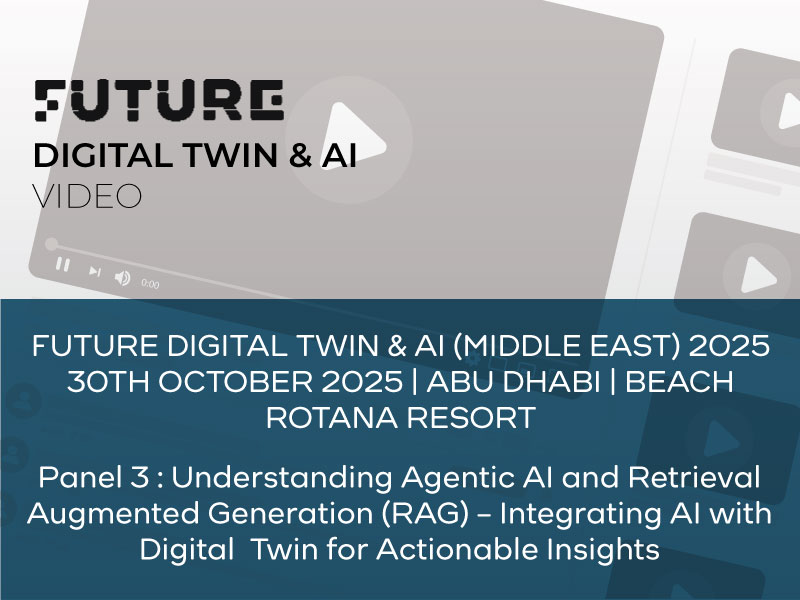
Understanding Agentic AI and Retrieval Augmented Generation (RAG) – Integrating AI with Digital Twin for Actionable Insights
Panel 3 opened with a discussion on how organisations can move from theory to practice when applying agentic AI and retrieval augmented generation within operational environments. The panellists reflected on the challenge of making advanced AI concepts accessible to teams working across upstream, downstream and facility operations. They agreed that the real opportunity lies in helping digital twins evolve from isolated models into systems that interact with live data, domain knowledge and user intent in a more dynamic and proactive way.
Contributors described how digital twins are already used in upstream settings to optimise clusters, wells and networks, but noted that agentic capabilities introduce a new layer of value. AI models that can learn, reason and adapt allow twins to shift from reactive optimisation towards a more holistic view of field performance. Speakers outlined how RAG can integrate trusted domain knowledge into AI driven workflows, while physics informed models ensure that recommendations remain aligned with first principles rather than drifting into abstract inference.
The session also examined the pressures created by rapidly expanding data volumes. Some operators now collect billions of data points daily, and panellists highlighted the need for AI systems that reduce cognitive load by drawing together legacy information, real time signals and contextual understanding. They explored how these models can shorten the time between identifying an issue and acting on it, narrowing decision cycles from weeks to minutes. Looking ahead, the group saw agentic AI as the next phase, offering prescriptive guidance and enabling more autonomous support while keeping engineers firmly in control.
Across the discussion, the panel stressed that successful adoption depends on clear data pathways, strong contextualisation and a shared approach to managing uncertainty. With these elements in place, AI can begin to extend the capability of digital twins, offering teams more reliable insight and improving operational confidence across the lifecycle of an asset.
Speakers
- Richard Mohan, Senior Specialist, Advanced Reservoir Solutions Subsurface Excellence Division, ADNOC
- Meaghan Snethlage, VP of Business Development, VEERUM
- Dr Erika A PÄRN, Research Scientist at New York University Abu Dhabi, S.M.A.R.T. Construction Research Laboratory
- Dr Wael Ziadat, SPE Chairman
Moderator
- Maryvi Yabet Santiago, Senior Engineer, Reservoir Management, ADNOC