

Artificial Intelligence is transforming every industry. New models are becoming more powerful, AI agents are automating complex tasks, and autonomous systems are quickly moving from concept to reality. Yet one challenge remains.
AI is only as intelligent as the context it receives.
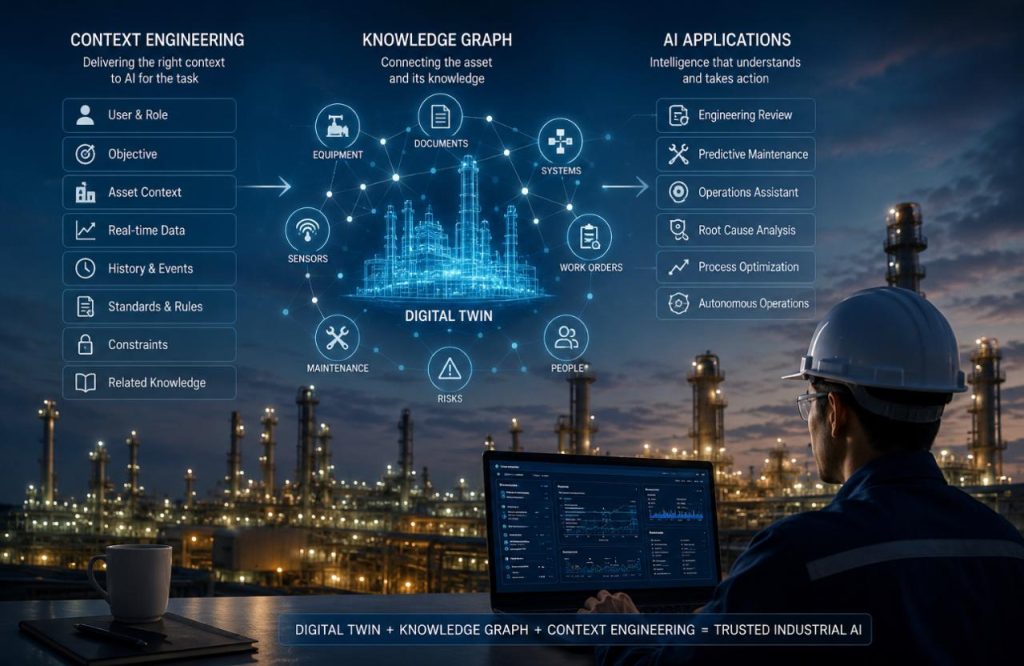
In industrial environments, context is far more than a prompt or a document. It includes engineering data, equipment history, real-time operating conditions, maintenance records, safety constraints, standards, and decades of engineering knowledge. Without this context, AI may generate convincing answers, but not necessarily the right ones.
This is why Context Engineering is becoming one of the most important disciplines in Industrial AI.
Beyond Prompt Engineering
Prompt engineering teaches AI what to do.
Context engineering gives AI what it needs to know.
Imagine asking an AI:
“Can Pump P-101 continue operating until the next shutdown?”
A traditional AI might retrieve a maintenance manual and the latest inspection report.
A context-aware AI understands much more:
- The pump belongs to a critical production train.
- Vibration has been increasing for the past month.
- A similar failure occurred twice before.
- The spare pump is currently unavailable.
- A planned shutdown is scheduled in six weeks.
- An inspection recommendation remains open.
The AI is no longer retrieving documents—it is reasoning within the operational context of the asset.
The Digital Twin Provides the Context
The Digital Twin has traditionally been viewed as a digital representation of a physical asset.
I believe its future role is much bigger.
A mature Digital Twin becomes the trusted source of lifecycle information, connecting engineering, construction, commissioning, operations, maintenance, inspection, and performance into a single view of the asset.
It provides the foundation upon which Industrial AI can understand what the asset is, how it operates, and where it is in its lifecycle.
The Knowledge Graph Connects the Knowledge
While the Digital Twin organizes information, the Knowledge Graph connects it.
It links equipment, documents, sensors, work orders, procedures, failure modes, risks, operating conditions, and people into a semantic network of relationships.
Instead of treating a pump, a drawing, and a maintenance record as separate data sources, the Knowledge Graph understands that they all describe the same asset and how they influence one another.
This transforms isolated data into connected industrial knowledge.
How They Work Together
Each technology has a distinct role:
- Digital Twin → Represents the asset.
- Knowledge Graph → Connects and understands the relationships.
- Context Engineering → Delivers the right information to AI for a specific task.
Together, they create the foundation for trustworthy Industrial AI.
Real Industrial Use Cases
This architecture has applications across the entire asset lifecycle:
AI-Assisted Engineering – Validate P&IDs, detect inconsistencies across engineering documents, and automate design reviews.
Autonomous Handover – Verify that every tag, document, certificate, and commissioning record is complete before operational acceptance.
Operations Support – Provide operators with recommendations based on real-time conditions, equipment history, procedures, and operational constraints.
Predictive Maintenance – Combine equipment health, maintenance history, inspection findings, spare availability, and production impact before recommending an intervention.
Root Cause Analysis – Connect alarms, process deviations, maintenance records, and previous incidents to identify likely causes faster.
Management of Change – Automatically identify the engineering documents, procedures, risk assessments, and systems affected by a proposed modification.
In every case, the quality of the AI depends on the quality of the context it receives.
The Foundation for Autonomous Operations
As industries move toward Autonomous Engineering and Autonomous Operations, context becomes even more critical.
An autonomous AI cannot make safe decisions using isolated documents or sensor values alone.
It must understand the asset, its relationships, its history, its operating constraints, and the consequences of every action.
That understanding comes from the combination of Digital Twins, Knowledge Graphs, and Context Engineering.
A Shift in Perspective
Perhaps we should stop asking:
“How can AI improve our Digital Twin?”
Instead, we should ask:
“How can our Digital Twin and Knowledge Graph provide trusted context for AI?”
That question changes everything.
The Digital Twin is no longer just a visualization platform.
The Knowledge Graph is no longer just a data model.
Together, they become the intelligence foundation that enables AI to reason, recommend, and eventually operate autonomously.
In my view, the organizations that succeed in the next decade will not simply have the most advanced AI models.
They will be the ones that build the richest industrial context.
Because in the age of Industrial AI, context is the new competitive advantage.
Global SVP, AI & Digital Engineering