Balancing Digital Twins & Artificial Intelligence – Maintaining Trust in an AI Driven Future
Calum MacLean Projects Director, Technical Marine Solutions
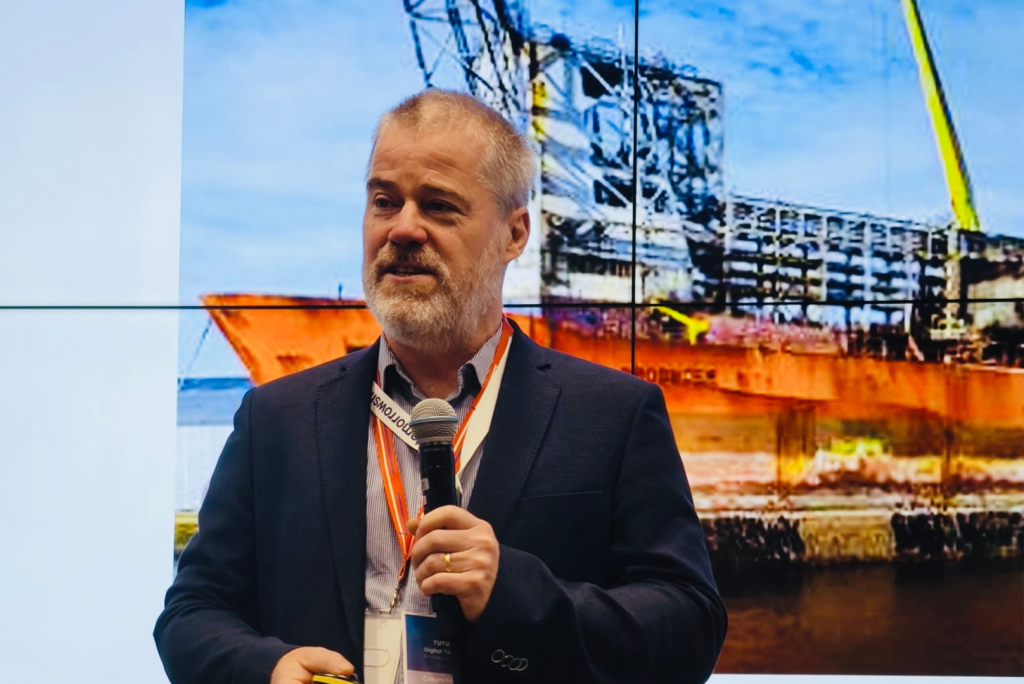
In this grounded and industry-specific presentation, Calum MacLean, Projects Director at Marine Technical Limits, explored how digital twins and artificial intelligence can enhance the integrity management of floating offshore structures—without compromising the trust, transparency, and engineering rigor that safety-critical systems demand.
Drawing from real-world experience supporting over 20 FPSOs annually, Calum MacLean introduced PYXIS, Marine Technical Limits’ digital platform for inspection, reporting, and risk-based integrity management. He outlined how Technical Marine Solutions leverages digital twins to centralise inspection data, streamline anomaly reporting, and support long-term asset life planning—all while integrating AI to accelerate data capture, task validation, and condition assessment.
However, Calum MacLean emphasised that AI should be applied with caution. He warned against over-reliance on automated insights without proper engineering context or validation, noting that trust can quickly erode if base data is flawed or human oversight is removed. Marine Technical Limits’ philosophy is clear: data quality must come first, AI must be used for mechanistic tasks like summarisation and cross-checking, and engineers must remain in control of safety-critical decisions.
The presentation also discussed how AI can help democratise access to asset insights and reduce variability in reporting, but only when embedded into modular, transparent, and traceable systems like PYXIS.
Calum MacLean’s key message: In the complex world of offshore asset integrity, success lies in finding the right balance between innovation and engineering discipline. AI is a powerful tool—but without realistic objectives, context, and continuous human validation, it risks undermining the very trust it aims to enhance.